

Our Verdict
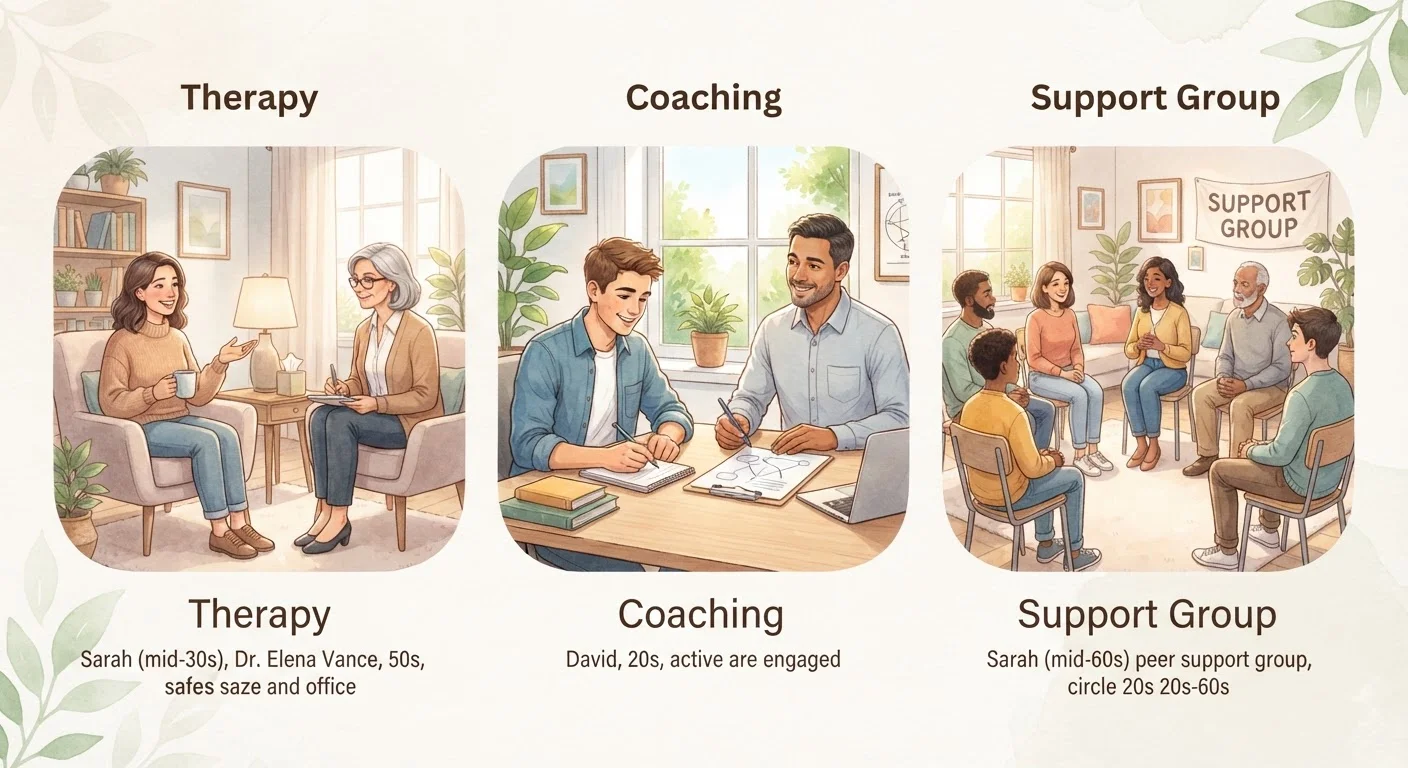
Therapy, coaching, and peer support each fill a distinct role in the mental wellness landscape. Therapy is the appropriate starting point for diagnosed conditions or serious emotional struggles. Coaching works well when life is broadly stable but direction or accountability is needed. Peer support adds community and shared understanding that neither professional option always provides.
| Best for | Recommended |
|---|---|
| Those managing mental health conditions or significant psychological distress | Therapy |
| Those seeking goal clarity, accountability, and personal growth | Coaching |
| Those wanting community, shared experience, and affordable ongoing connection | Peer Support |
| Those navigating complex challenges across multiple life areas | A combination of all three |
Why the Distinction Matters
When you're deciding where to turn for mental and emotional support, the choices can feel overwhelming — and the labels don't always help. "Therapy," "coaching," and "peer support" are often used loosely, yet each represents a genuinely different type of relationship, purpose, and professional (or non-professional) framework.
Choosing the right fit isn't just about preference; it has real implications for your safety, progress, and wellbeing. Someone experiencing clinical depression, for example, needs a different level of care than someone feeling stuck in their career. Understanding what each option actually involves helps you make an informed decision rather than a default one.
For a grounding in the vocabulary you'll encounter when researching these options, see our mental wellness terms reference guide.
| Therapy | Coaching | Peer Support | |
|---|---|---|---|
| Provider type | Licensed mental health professional | Certified or uncertified coach | Person with lived experience |
| Regulatory oversight | State-licensed, regulated | Unregulated in most US states | Varies by setting; minimal formal oversight |
| Primary focus | Diagnosing and treating mental health conditions | Goal-setting and personal growth | Shared experience and community connection |
| Time orientation | Past and present patterns | Future-focused outcomes | Present experience and shared stories |
| Typical cost | Covered by insurance; varies by provider | Generally out-of-pocket; wide range | Often free or low-cost |
| Best suited for | Mental health conditions, trauma, distress | Career, life goals, accountability | Isolation, shared understanding, ongoing support |
Therapy: Clinically Grounded Mental Health Care
Therapy — also called psychotherapy or counseling — is delivered by licensed mental health professionals such as psychologists, licensed clinical social workers (LCSWs), or licensed professional counselors (LPCs). These practitioners are trained to assess, diagnose, and treat mental health conditions using evidence-based approaches.
Common modalities include Cognitive Behavioral Therapy (CBT), Dialectical Behavior Therapy (DBT), and trauma-focused approaches. Therapy is regulated: practitioners must meet licensure requirements set by their state, carry professional liability, and adhere to ethical codes.
Therapy is appropriate when someone is experiencing symptoms of anxiety, depression, trauma, grief, relationship difficulties, or other conditions that meaningfully affect daily functioning. It is also the appropriate route if you are unsure whether what you're experiencing has a clinical dimension — a licensed professional is qualified to make that assessment.
Unsure Where to Start? Ask Your Doctor
If you're uncertain whether therapy, coaching, or peer support is right for your situation, a conversation with your primary care physician is a practical first step. They can help screen for clinical conditions, provide referrals to licensed mental health professionals, and point you toward community resources — all without requiring you to self-diagnose first.
This article is for informational purposes only and is not a substitute for professional mental health advice. If you are experiencing significant distress, please consult a qualified mental health professional.
Coaching: Goal-Focused and Forward-Looking
Life or executive coaching is oriented around goals, performance, and personal development rather than psychological treatment. Coaches help clients identify what they want, build accountability structures, and work through practical obstacles. The relationship is typically future-focused rather than exploring past patterns or underlying conditions.
It's important to understand that coaching is not a licensed profession in most US states. While many coaches hold certifications from organizations such as the International Coaching Federation (ICF), there is no universal regulatory body. This means quality and training vary considerably. Coaches are not permitted to diagnose or treat mental health conditions.
Coaching tends to be a strong fit when someone's life is broadly stable but they feel directionless, want career clarity, or are pursuing a specific goal such as launching a business or improving leadership skills. It is not an appropriate substitute for therapy when clinical symptoms are present.
Coaching Is Not a Clinical Service
Because coaching is largely unregulated, some practitioners may use language that implies therapeutic or clinical capabilities they are not licensed to provide. If a coach claims to treat mental health conditions or diagnose you with anything, that is a significant red flag. Anyone experiencing clinical symptoms should seek a licensed mental health professional, not a coach.
Peer Support: Community, Shared Experience, and Belonging
Peer support refers to assistance offered by people with lived experience of a particular challenge — not professional credentials. This can take the form of support groups (in-person or online), peer support specialists in healthcare settings, or informal community networks.
Research consistently points to the value of social connection for emotional resilience. Peer support provides something neither therapy nor coaching always offers: the genuine understanding of someone who has navigated a similar experience. It can reduce stigma, combat isolation, and sustain motivation between professional appointments.
Peer support is not clinical care. Peer support specialists who work within healthcare systems typically receive training, but community-based groups operate with varying levels of structure. The quality and tone of groups can differ significantly. That said, peer support is often the most accessible and affordable option, and it works best when combined with other forms of care rather than as a standalone solution for serious conditions.
Pair peer support with consistent self-care practices — our guide on everyday habits that support emotional resilience outlines small, research-linked practices that complement any support structure. Reflective practices like journaling can also reinforce the insights gained in any of these settings — explore journaling approaches for mental clarity for practical starting points.
46%
Adults with mental illness who receive treatment
According to the National Alliance on Mental Illness (NAMI), fewer than half of US adults with a mental health condition receive treatment in a given year, underscoring the role all support options can play.
70%+
Peer support programs showing measurable benefit
A review published in Psychiatric Services found that the majority of peer support programs studied reported improvements in recovery-oriented outcomes such as hope, empowerment, and social inclusion.
How to Choose — or Combine
These three forms of support are not competing options; they serve different functions and are frequently used together. A person might work with a therapist to address anxiety, engage a coach for career development, and attend a peer support group for community connection — all at the same time.
A few guiding questions can help you find your starting point:
- Are you experiencing symptoms that affect daily functioning — sleep, mood, relationships, work? Start with a licensed therapist or your primary care provider.
- Are you feeling stuck or directionless without clinical symptoms? Coaching may be a useful fit.
- Do you feel isolated or want connection with others who understand your experience? Peer support can offer meaningful community alongside other care.
When in doubt, a conversation with your primary care physician is a practical first step — they can help you understand whether a clinical referral is appropriate. Never delay seeking professional help in favor of a less intensive option if significant distress is present.
The content on this site is for informational purposes only and is not a substitute for professional advice. Always consult a qualified professional for guidance specific to your situation.